

I Know Nothing About Coffee
allow me a moment of end-of-research rant (I promise it's less negative than it seems)

Welcome to this week’s Over-Extracted. I am officially in the last stages of my thesis on specialty coffee, and this week I couldn’t help but to be lost in thought. There is so much I don’t know about coffee so far — and it was quite a journey to discover what makes up the unknown, even for just a little bit.
I was musing on my matcha brownie and drinking my afternoon coffee on Saturday. I guess I was supposed to reflect on the drink itself, a cup of iced pomelo juice espresso, a category that isn’t nearly as popular in Mexico as in Asia. But my head went over yonder to where the coffee might have come from, to the fields and farms I’ve visited over two years of research on specialty coffee in Latin America, and a familiar unease washed over me.
The closer I approach the end of my thesis, the more I am overtaken by the so-called imposter syndrome: the feeling that, in fact, I know nothing about coffee.
Things were very different when I first began obsessing over coffee, like anyone who falls in love with anything. The idealization, the romanticization, the thrill of learning one more thing about it, all that jazz. I spent many mornings trying out different brew recipes, and a great deal of money trying out new beans from everywhere possible. I visited many farms and worked briefly in one.
When I thought about the origins then, there was nothing but good vibes: I saw hardworking, passionate people experimenting with new techniques in processing, I saw ecological farming taking effect, I saw good work turning into good money. At a time defined by crisis and disillusion, a time of questioning whether our dreams and endeavors would ever become tangible accomplishments, specialty coffee felt like an idyllic escape.
And that might still be true. When I look back into those fields now, however, I do notice that I left out a lot of details. As someone trained in social sciences and brought up in a densely populated city in China, I’ve had zero lived experience in the rural world. My city, Shenzhen, is known as home to the big techs, cheap electronics, and a brutal office culture—literally the opposite of what the countryside stands for.
My world was made of urban trouble: neighborhood relations, traffic, media, diminishing public spaces. Neither of my parents nor any of my grandparents were farmers. I didn’t know my fruits and vegetables by playing with them in the field; I knew them in supermarkets. I might have taken a few trips to the countryside, but I certainly didn’t stay long enough to get a true feel of rural life: its everyday rhythm, its smell, its colors, its sense of space. Rurality existed mostly as the antithesis to my urban reality: it is, I assumed, what the city is not.
Needless to say, my agricultural knowledge was practically null when I started drawing myself close to coffee. From reading the transparency notes on specialty coffee packages, I learned my very basics: altitude matters to quality, there are countless varieties of arabica coffee, coffee could only thrive under certain climates, etcetera. I then learned more about the effects of crop diseases, extreme weather, and other problems that could occur in a farm.
But something’s still missing.
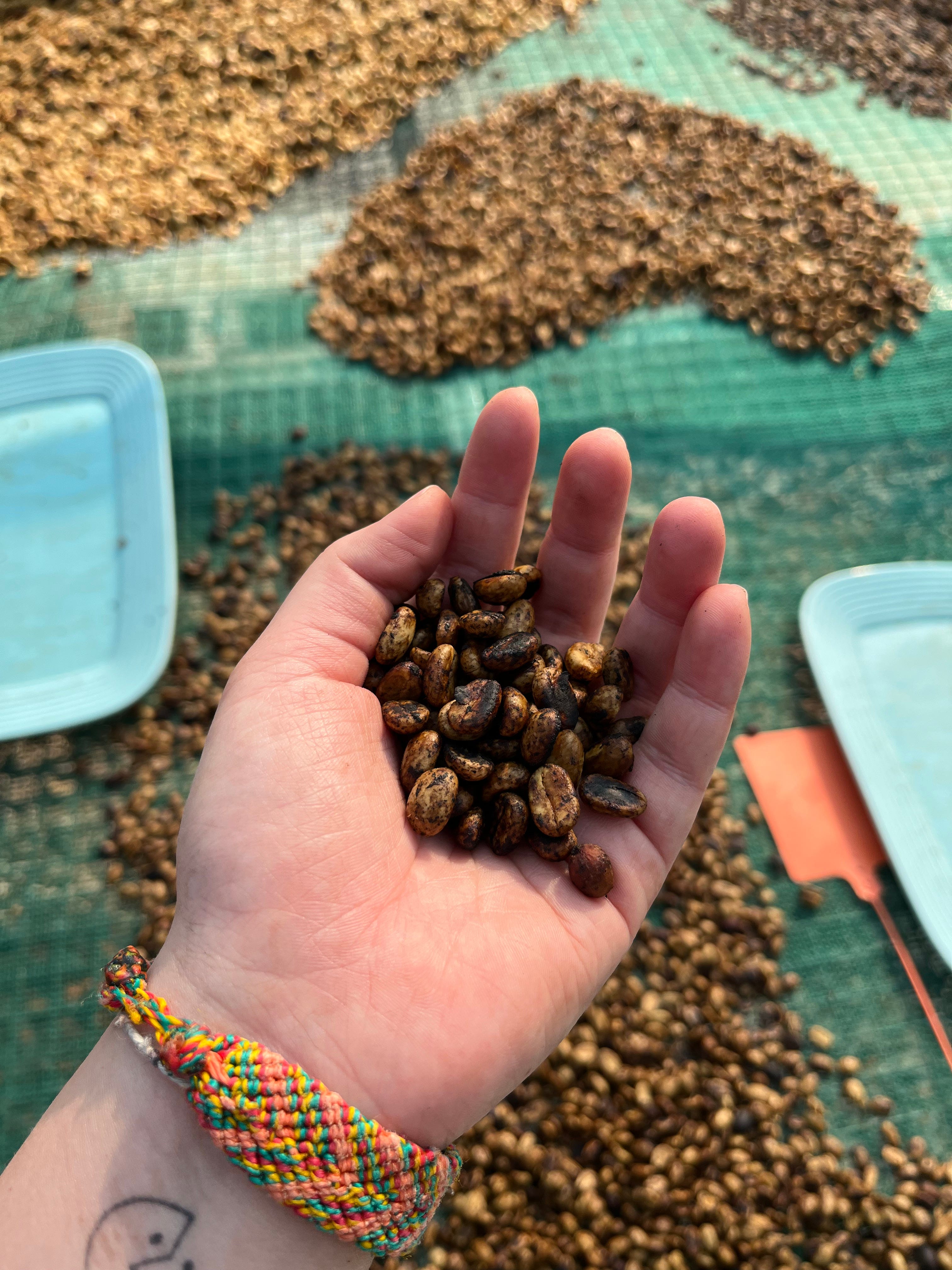
I definitely didn’t know exactly what I didn’t know when I began my research two years ago. When I finally found myself in specialty coffee farms in Guatemala, Costa Rica, and Colombia, places and landscapes I only imagined, I wanted to figure out what makes specialty coffee special. In preparation, I had read books on value theories, time studies, and economic anthropology—things I found eye-opening while I was reading them.
Except that they don’t always match the reality I encounter. Throughout the conversations with my dear producer friends, I sense that my preconception of their businesses was disproportionately shaped by my abstract book learning. Their day-to-day is spent figuring out how a grafted plant adapted, how to respond to unexpected rainfall, how to open up land for a new variety, or which workers to hire for the harvest season: a million tiny details.
If my only concern was to find a theory angle and extract fancy concepts for my degree, perhaps I would feel a little less apprehensive. Instead, I was taking my best shot to fully immerse myself in the life of the farm, try to worry about what worries the producers, and try to speak their language. This is quite something else, and a rather unrealistic attempt, considering I was only given two years for the research.
The more I go back to the field, therefore, the more inadequate I feel about speaking of farm affairs, because the vital activities of the farm consist of something I have only just begun to make sense of: money and land.
Even though I have covered economy in my journalistic career and studied the restaurant business in college, I somehow evaded all things money. I wasn’t very interested in bookkeeping nor very sensitive to numbers. I succumbed to being bad at math and decided numbers don’t have to matter—until they do. The entire concept of specialty coffee is built on how to sell coffee at a better price and justify that price with quality. There is no way to measure whether a specialty coffee project is working without looking at the numbers. Indeed, there is no way to assess whether anything about coffee works without looking at the numbers; before anything, coffee is a trade.
On the other hand, growing coffee quickly went from a vague but photogenic concept to something very technical. Making sure coffee grows in the field and yields a harvest—not one coffee tree, but thousands of them—requires knowing the soil, supervising how a varietal adapts to the ecosystem, optimizing spaces between plants, choosing shade trees, and fertilizing correctly, among others. I did my best to catch up, but eventually I concluded: without years of agricultural practices, without sufficient bodily experiences in the field, I wouldn’t truly get to the bottom of how coffee producers or workers make their decisions, what exactly goes into their calculus, or what defines their identity.
The impossibility of traversing this distance at the final stages of my research was, apparently, what constituted my unease. I know nothing about coffee because coffee production, a fundamental part of what makes coffee what it is, is not a reality I could fathom.
I don’t intend to write an essay of self-pity, however. It is a little frustrating not getting to the bottom of the question I set out to explore, but given the time constraint, no one could expect to know everything there is. Knowing what I don’t know is certainly a step forward from not knowing it. And it didn’t stop me from being fascinated with coffee—even if I must admit, the romanticizing stage is behind me.